About Me

My photo
New Delhi, NCR of Delhi, India
I am an Indian, a Yadav from (Madhepura) Bihar, a social and political activist, a College Professor at University of Delhi and a nationalist.,a fighter,dedicated to the cause of the downtrodden.....
Showing posts with label Congress Party. Show all posts

Saturday, November 16, 2013

कांग्रेस लीला के शिकार लालू प्रसाद: (Laloo Prasad)


सियासी ज़िन्दगी में हाल के दिनों में रोज़ कांग्रेस-सोनिया का नाम जपने वाले लालू प्रसाद को सी बी आई कोर्ट ने सजा सुनायी और उन्हें राहत देने वाले अध्यादेश को राहुल बाबा ने नॉनसेंस कह कर उसकी हवा निकल दी। इधर कांग्रेस जद(यू) से ताल-मेल की बात का खंडन नहीं किया। इस बेवफाई के बावजूद रा ज द का कांग्रेस-प्रेम बरक़रार रहा।

इधर हुंकार रैली में जैसे ही नरेंद्र मोदी ने यदुवंशियों से उन्हें समर्थन देने की अपील की,कांग्रेस कि नींद उड़ गयी। राजनैतिक जोड़-घटाओ करते हुए उन्हें नज़र आया कि अगर यादवों का एक अंश भी नरेंद्र मोदी के साथ हो जाता है तो बिहार में चुनाव नतीजों को भा ज पा के पक्ष में एक तरफ़ा माना जा सकता है।

तब उन्हें लगा कि बिना लालू प्रसाद को जेल से बाहर निकले और रा ज द से ताल-मेल किये , बात नहीं बनेगी।

इसके लिए माहौल बनाने का भार कांग्रेस नीत पत्रिका तहलका को सौंपा गया जिसमें इसके संवाददाता अजित शाही लिखते हैं:
चारा घोटाले में बिहार के पूर्व मुख्यमंत्री लालू प्रसाद को सजा दिए जाने का कोई विशेष आधार नहीं है और फैसला अस्पष्ट, हलके और विकृत सबूत पर आधारित है।

निचले अदालत से सजायाफ्ता आजीवन कारावास पाये हुए पप्पू यादव उच्च न्यायलय से बाइज्जत बरी हुए हैं। तो क्या लालू प्रसाद को बचाना कांग्रेस के लिए बड़ी बात थी?


पहले फंसाओ और फिर बचा कर अहसान के बोझ तले दबा कर काम निकालो, कांग्रेस की निति रही है। लालू प्रसाद यह समझे कि नहीं, उनके समर्थक तो ज़रूर समझ रहें होंगे।

Sunday, August 26, 2012

रासबिहारी लाल मंडल (१८६६-१९१८) - मिथिला के यादव शेर.

अगर बिहार के आधुनिक इतिहास में पिछड़े वर्ग के और यादव समाज के प्रथम क्रन्तिकारी व्यकित्व का उल्लेख किया जाये तो मुरहो एस्टेट के ज़मींदार रासबिहारी लाल मंडल का ही नाम आयेगा. ज़मींदार होते हुए भी स्वतंत्रता आन्दोलन में सक्रीय और कांग्रेस पार्टी में बिहार से स्थापना सदस्यों में एक रासबिहारी बाबू का साथ सुरेन्द्र नाथ बनर्जी, बिपिन चन्द्र पाल, सच्चिदानंद सिन्हा जैसे प्रमुख नेताओं से था. १९०८ से १९१८ तक प्रदेश कांग्रेस कमिटी और ए आई सी सी के बिहार से निर्वाचित सदस्य थे. १९११ में गोप जातीय महासभा (बाद में यादव महासभा) की स्थापना के साथ, यादवों के लिए जनेऊ धारण आन्दोलन और १९१७ में मोंटेग-चेल्म्फोर्ड समिति के समक्ष यादवों के प्रतिनिधिमंडल का नेतृत्व करते हुए, वायसरॉय चेल्म्फोर्ड को परंपरागत 'सलामी'देने की जगह उनसे हाथ मिलते हुए जब यादवों के लिए नए राजनैतिक सुधारों में उचित स्थान और सेना में यादवों के लिए रेजिमेंट की मांग की तो वे भी दंग रह गए. १९११ सम्राट जार्ज पंचम के हिंदुस्तान में ताजपोशी के दरबार में प्रतिष्टित जगह से शामिल हो कर वह उन अँगरेज़ अफसरों को भी दंग कर दिए जिनके विरुद्ध वे वर्षों से कानूनी लड़ाई लड़ रहे थे. कांग्रेस के अधिवेशन में वे सबसे पहले पूर्ण स्वराज्य की मांग की. कलकत्ता से छपने वाली हिंदुस्तान का तत्कालीन प्रतिष्टित अंग्रेजी दैनिक अमृता बाज़ार पत्रिका ने रासबिहारी लाल मंडल की अदम्य साहस और अभूतपूर्व निर्भीकता की प्रशंसा की और अनेक लेख और सम्पादकीय लिखी, और दरभंगा महराज ने उन्हें 'मिथिला का शेर' कह कर संबोधित किया . २७ अप्रैल, १९०८ के सम्पादकीय में अमृता बाज़ार पत्रिका ने कलकत्ता उच्च न्यायलय के उस आदेश पर विस्तृत टिप्पणी की थी जिसमें भागलपुर के जिला पदाधिकारी लायल के रासबिहारी बाबू के प्रति पूर्वाग्रह से ग्रसित व्यवहार को देखते हुए उनके विरुद्ध सभी मामले को दरभंगा हस्तांतरित कर दिया था. रासबिहारी बाबू के वकील जैक्सन ने न्यायलय को बताया था की चूँकि तत्कालीन जिला पदाधिकारी सीरीज को १९०२ में मधेपुरा में अदालत और डाक बंगले के निर्माण के लिए काफी भूमि देने के बाद भी, लायब्रेरी के लिए एक बड़े भूखंड (जहाँ अभी रासबिहारी विद्यालय स्थित है) मांगे जाने पर उसे देने से इनकार कर दिया, तब से स्थानीय प्रशासन और पुलिस के निशाने पर आ गए हैं, और उनके विरुद्ध १०० से अधिक मामले दर्ज किये गए हैं, और लगभग एक दर्ज़न बार बचने के लिए उन्हें उच्च न्यायालय के शरण में आना पड़ा है. यह संयोग नहीं है की गिरफ्तार होने से पहले ज़मानत (जिसे आज कल अग्रिम ज़मानत कहते हैं, और जो आम है) हिंदुस्तान के काननों के इतिहास में सबसे पहले रासबिहारी लाल मंडल को ही दिया गया. रासबिहारी लाल मंडल का जन्म मुरहो, मधेपुरा के ज़मींदार रघुबर दयाल मंडल के एकमात्र पुत्र के रूप में हुआ. बचपन में ही उनके माँ-बाप की मृत्यु हो गयी, और तब रानीपट्टी में उनकी नानी ने उनका लालन-पालन किया. रासबिहारी बाबू ११वी तक पढ़े, और हिंदी, उर्दू, मैथिलि, फारसी, संस्कृत, अंग्रेजी और फ्रेंच भाषा का उन्हें ज्ञान था, और हर रोज़ मुरहो में उनके पलंग के बगल में तीन-चार अख़बार उनके पढने के लिए रखा रहता था. रासबिहारी लाल मंडल ने १९११ में यादव जाति के उत्थान के लिए मुरहो, मधेपुरा (बिहार) में गोप जातीय महासभा की स्थापना की. इस महान कार्य में उनका साथ दिया बांकीपुर(पटना) के श्रीयुत्त केशवलाल जी, देवकुमार प्रसादजी, संतदास जी वकील, सीताराम जी, मेवा लाल जी, दसहरा दरभंगा के नन्द लाल राय जी,गोरखपुर के रामनारायण राउत जी, छपरा के शिवनंदन जी वकील, जमुना प्रसाद जी, जौनपुर के फेकूराम जी, सलिग्रामी मुंगेर के रघुनन्दन प्रसाद मुख़्तार जी, हजारीबाग से स्वय्म्भर दासजी, लखनऊ के कन्हैय्यालाल जी, मुरहो, मधेपुरा से ब्रिज बिहारी लाल मंडल जी, रानीपट्टी से शिवनंदन प्रसाद मंडल जी एवं मधेपुरा से लक्ष्मीनारायण मंडल जी. रासबिहारी बाबू ने अपने स्वागत भाषण में इस सभा के उद्देश्य को रेखांकित किया - सनातनधर्मपरायणता, विद्याप्रचार, विवाह विषयक संशोधन, सामाजिक आचरण संसोधन, कृषि, गोरक्ष वान्निज्यो - व्रती, पारस्परिक सम्मलेन, मद्य निषेध तथा अनुचित व्यय निषेध. यह महासभा के संस्थापकों की दूरदृष्टी ही थी जिसके अनुरूप उन्होंने शिक्षा प्रसार को महत्व दिया और स्कूल कालेजों की स्थापना के साथ साथ यादव छात्र- छात्राओं के लिए होस्टलों एवं वजीफे क इंतजाम करने का प्रयास किया जिससे डाक्टर, इंजीनियर बनने के अलावे आई ए एस व आई पी एस भी बनें. प्रत्येक जिले में यादव भवन व संगठन बनाये जाने और 'गोपाल-मित्र' मासिक पत्रिका का मुद्रण का लक्ष्य रखा गया. अपने भाषण के समाप्ति में उन्होंने कहा -" उत्थवयं , जागृतवयं,जोक्तवयं भूति कर्माषु. भावोष्यतीत्येव मनः कृत्वा सततमव्यथै. - उठाना चाहिए जागना चाहिए सत कार्यों में सदैव प्रवृत रहना चाहिए और ढृढ़ विश्वास रखना चहिये की सफलता हमें अवश्य प्राप्त होगी." इस प्रयास पर रासबिहारी बाबू के पौत्र न्यायमूर्ति राजेश्वर प्रसाद मंडल ( पटना उच्च न्यायलय के प्रथम यादव न्यायाधीश) ने कहा था - " अंग्रेजों ने शिक्षा को मंदिर मस्जिद से निकाल कर जनता की झोली में डाल दिया. किन्तु धर्म के द्वारा स्थापित बंधनों पर सबसे बड़ा अघात तब लगा जब बाबू रासबिहारी लाल मंडल ने आवाज़ दी की तोड़ डालों इन बंधनों को, मिटा दो शोषण के इस रीति-रिवाजों को. ब्राहमण ग्रंथों के अनुसार शुद्र समुदाय की श्राद्ध क्रिया को एक माह तक चलनी चाहिए. जनेऊ संस्कार के हकदार ऊँची जाति के ही लोग हुआ करते थे. मंडल जी ने इन पाबंदियों को तोड़ डाला. इनके प्रोत्साहन पर जन समुदाय बारह दिनों में ही श्राद्ध क्रम करने लगे. जेनू धारण करने लगे. एक नया संस्कार जग उठा, एक नया जागरण हुआ." बाद में समाजशास्त्रियों ने इसे "संस्कृतिकरण" कहा. वैसे इसका उच्च जातियों द्वारा पुरजोर विरोध भी हुआ. मुंगेर जिला में यादवों और भुमियारों के बीच संघर्ष हुआ. दरभंगा में तो जनेऊ धारण करने वाले यादवों को दाग दिया गया था. परन्तु रासबिहारी बाबू अपने प्रयास में आगे बढ़ते रहे. उन्होंने ब्राह्मो-समाज के साथ मिलकर ग्राम-सुधार कार्यक्रम भी चलाये. सांप्रदायिक ईर्ष्या-द्वेष, जाति-व्यवस्था, अस्पृश्यता,सती-प्रथा, बाल-विवाह, अपव्यय और ऋण, निरक्षरता और मद्यपान, जसी सामाजिक कुरीतियों के विरुद्ध कई सभाएं की. कांग्रेस के १९१८ के कलकत्ता अधिवेशन के दौरान वे बीमार पद गए और ५१ वर्ष की अल्प-आयु में बनारस में २५-२६ अगस्त,१९१८ को रासबिहारी लाल मंडल का निधन हो गया. यह संयोग ही था की उसी दिन बनारस में ही रासबिहारी बाबू के सबे छोटे पुत्र बी पी मंडल का जन्म हुआ. रासबिहारी लाल मंडल के बड़े पुत्र भुब्नेश्वरी प्रसाद मंडल थे जो १९२४ में बिहार-उड़ीसा विधान परिषद् के सदस्य थे, तथा १९४८ में अपने मृत्यु तक भागलपुर लोकल बोर्ड (जिला परिषद्) के अध्यक्ष थे. दूसरे पुत्र कमलेश्वरी प्रसाद मंडल आज़ादी की लड़ाई में जय प्रकाश बाबू वगैरह के साथ गिरफ्तार हुए थे और हजारीबाग सेन्ट्रल जेल में थे और १९३७ में बिहार विधान परिषद् के सदस्य चुने गए.
बी पी मंडल १९५२ में मधेपुरा विधान सभा से सदस्य चुने गए. १९६२ पुनः चुने गए और १९६७ में मधेपुरा से लोक सभा सदस्य चुने गए. १९६५ में मधेपुरा क्षेत्र के पामा गाँव में हरिजनों पर सवर्णों एवं पुलिस द्वारा अत्याचार पर वे विधानसभा में गरजते हुए कांग्रेस को छोड़ सोशिअलिस्ट पार्टी में आ चुके थे. बड़े नाटकीय राजनैतिक उतार-चढ़ाव के बाद १ फ़रवरी,१९६८ में बिहार के पहले यादव मुख्यमंत्री बने. Rash Behari Lal Mandal v. Emperor 12 C.W.N. 117 : 6 C.L.J. 760 : 6 Cr. L.J. 408 where it was held that "the High Court has full jurisdiction under Section 437 of the Criminal Procedure Code to revise a commitment order made under Section 436 on points of law as well as of facts." In Rash Behary Lal Mandal v. Emperor (1908) 35 Cal. 1076, it was held by a Bench of the Calcutta High Court that a warrant of arrest which had been illegally issued under Section 96, Criminal P.C., could not be treated as valid under Section 98.

Late Lamented Rash Behari Lal Mandal, the Yadav King and Lion of Mithila

The editorial of 27th April,1908 Amrita Bazar Patrika, the renowned daily of India then, published from Calcutta was all praise for Rash Bihari Lal Mandal, the Zamindar of Murho Estate, Madhepura for having taken headlong Mr FF Lyall, the haughty Disrtict Magistrate of Bhagalpur, and Mandal's petition at Calcutta High Court for transfer of his cases from Bhagalpur to Darbhanga on the ground of prejudiced attitude of Lyall had been accepted. Lyall raked the issue again by making defamatory comments against the Justices of Calcutta High Court on the order, and was again hauled for it. Before that the 22nd February, 1908 issue of Amrita Bazar Patrika had reported the issue, according to which Mr Jackson, the Lawyer of Rashbihari Lal Mandal had argued before Justice Geidt that since 1902, when Mandal had refused to part with a certain piece of Land at heart of Madhepura (where now Rashbihari Vidyalay stands) on the orders of the Mr Shirres, the then District Magistrate, had incurred the wrath of the administration and police. Since then series of criminal cases were brought against Mr Mandal and he had to move to High Court more than a dozen of times to save himself. It was not a mere coincidence that the first person to be granted bail before arrest (so common these days as Anticipatory Bail), on the orders of Calcutta High Court was Late Rashbihari Lal Mandal. The Gazetteer of Bhagalpur District has also mentioned the extraordinary case of Rashbihari Lal Mandal. Late Rashbihari Lal Mandal had many distinctions to his credit. Born in 1866 to Raghubar Dayal Mandal, the Zamindar of Murho, he had inherited considerable property at Ranipatti also. Rashbihari Lal's parents died when he was very young and he had to look after his estate since adolescence. He was educated till Class XI and knew many languages including Sanskrit, Hindi, Maithili, English, Urdu, Persian and French. Everyday newspaper in various languages were by his bedside at Murho. By 1908 Rashbihari Lal Mandal had come to the forefront of the National Movement, started his contribution in the Social Justice Movement and continued his legal crusade against the British rulers. However, late Rashbihari Lal Mandal also made history by attending the coronation of King GeorgeV at Delhi and also by leading a delegation of Yadav leaders to Montagu-Chelmsford Committee to demand rights for Yadav's and also to establish Ahir Regiment in the Army. Here he shook hands with Lord Chelmsford rather than rendering the traditional 'salami' to the Viceroy. Rashbihari Lal Mandal was the first leader of Yadav Community, nay the Backward Classes, to be the elected Member of Provincial Congress Committee and the All India Congress Committee from Bihar. He came in contact with Surendra Nath Bannerjea, Bipin Chandra Pal,Sachidanand Sinha and other Congress leaders at Calcutta, and remained on the forefront of the Congress leadership of Bihar till his death in 1918. Dr Rajendra Prasad had confided with Late B P Mamdal, the youngest son of late Rashbihari Lal Mandal in 1952, when he had gone to seek Congress ticket for Vidhan Sabha, that Rashbihari Babu used to be our inspiration and guide us at Calcutta when we were students. Rashbihari Lal Mandal organised the first GopeJatiy Mahasabha (later christened as Yadav Mahasabha) at Murho, Madhepura in December, 1911. The other Yadav leaders who had joined him in this endeavor included Keshav Lal, Devkumar Prasad, Sant Das(Pleader), Sita Ram, Mewa Lal from Bankipore (Patna), Kanhaiya Lal (Lucknow), Ram Narayan Raut (Gorakhpur), Shiv Nandan Prasad(Pleader), Jamuna Prasad(Chhapra), Feku Ram (Jaunpur), Nandlal Rai (Dashara, Darbhanga), Ram Dhani Gope, Ram Dhyan Prasad (Muzaffarpur), Syambhardas (Hazaribagh), Raghunandan Prasad (Saligrami,Munghyr), Brij Bihari lal Mandal, Shiv Nandan Prasad Mandal (Madhepura). The resolutions adopted at the Mahasabha included steps to improve education among Yadav's by establishing, Schools, Colleges, Boarding Houses and giving stipends, stopping Child-Marriage, ending Dowry System, staying away from Liquor consumption, improving Agriculture practices, protecting Cows, taking part in Commerce, avoid fight among themselves, establish Gope Jatiy Buildings and organisation in every district with a Secretary, bring out a Monthly Magazine "Gopal Mitr" and have a session of Mhasabha annually at different places. The most important step taken by the Mahasabha was what was later called "Sanskritisation" by Sociologists, or holding of 'Janaiu Dharan' ceremony. This was vehemently opposed by the upper caste and caste clashes took place at Munger while the Yadav's who had donned sacred thread were cauterised. It was a unique coincidence that when Late Rash Bihari Lal Mandal breathed his last at a young age of 51 at Benaras on 25th-26th
August 1918, it was here that his youngest son B P Mandal, former Chief Minister of Bihar was born. Rashbihari Babu's eldest son was Bhubneshwari Prasad Mandal, Member, Bihar-Orissa Legislative Council in 1924 and Chairman, Bhagalpur Local Board (District Board) till his death in 1948, and second son was Kamleshwari Prasad Mandal, member, Bihar Legislative Concil in 1937. His eldest grandson Justice Rajeshwar Prasad Mandal was the first Yadav Judge of Patna High Court. Other grandsons including Suresh Chandra Yadav was Ex-MLA, Ramesh Chandra Yadav, Advocate was Chairmn of Bhumi Vikas Bank, Director, Madhepura-Supaul Central Co-operative bank and Ward Commissioner, Madhepura Municiapality and Manindra kumar Mandal, Ex-MLA. *************************************************************************************
Rash Behari Lal Mandal v. Emperor 12 C.W.N. 117 : 6 C.L.J. 760 : 6 Cr. L.J. 408 where it was held that "the High Court has full jurisdiction under Section 437 of the Criminal Procedure Code to revise a commitment order made under Section 436 on points of law as well as of facts."
Rash Behari Lal Mandal and Ors. v. The Emperor (1907) 12 C.W.N. 117. Under the Codes of 1871 and 1892 it has been held that this Court will not exercise its power of revision on the ground that the lower Court has not rightly appreciated the evidence the reason being that it is for the Court called upon to determine whether the person charged is guilty or not, to consider and weigh the evidence, and any error as to the probative force and effect is not open to correction on revision, but only on appeal.
In Rash Behary Lal Mandal v. Emperor (1908) 35 Cal. 1076, it was held by a Bench of the Calcutta High Court that a warrant of arrest which had been illegally issued under Section 96, Criminal P.C., could not be treated as valid under Section 98.

Tuesday, July 31, 2012

पी. चिदंबरम - दागी या प्रतिभावान? Chidambaram - Tainted or Talented?

तो पी. चिदंबरम को पुनः वित्त मंत्री बनाया गया है. या तो कांग्रेस में talent की कमी है, अथवा सिर्फ tainted ही बचे है.
 ये तमाशा देख कर हम आईना-बेज़ार हैं ,
जिनके चेहरे ही नहीं वो आईना-बरदार हैं.
ऐ मेरी जम्हूरियत! तेरी कहानी है अजीब,
काबिल-ए-नफरत हैं जो, वो साहब-ए-किरदार हैं.

देखने वाली बात यह होगी की 2 जी में चिदंबरम की भूमिका के बारे में सुब्रमनियम स्वामी की सर्वोच्च न्यायालय में लंबित याचिका में अगर प्रथम दृष्टया सही पाती है और कार्यवाई की आदेश देती है तो अगला वित्त मंत्री कौन होंगें?

पी.चिदंबरम पर अन्य आरोप- १) एयरसेल-मक्सिस सौदा विवाद, जिसमें उनके बेटे कार्तिक चिदंबरम पर आरोप है.

                            २)काला धन- चिदंबरम पर विदेशों में काला धन संचय करने के आरोप लगे है, जिसपर उसने कोई सफाई नहीं दी है. 

                            ३)एनरोन का वकालत- दिवालिया अमरीकी कंपनी एनरोन का वकील थे.

                            ४) १० जुलाई १९९२ को भारत सरकार के वाणिज्य राज्यमंत्री पद से फेयरग्रोथ कंपनी, जो प्रतिभूति घोटाले में शामिल थी, में निवेश करने पर इस्तीफा दिया.

                            ५) वित्तमंत्री रहते उनके स्वैच्छिक आय प्रकटीकरण योजना या Voluntary Disclosure of Income Scheme (VDIS) को भारत के नियंत्रक और महालेखा परीक्षक ने अपनी  रिपोर्ट में इस योजना की निंदा करते हुए इसे वास्तविक करदाताओं के लिए अपमानजनक और धोखाधडी बताया.

                            ६) महंगाई के अनेक कारण हैं. उनमें एक है पी. चिदंबरम की देन - पी नोट्स, जो पूरी दुनिया में सिर्फ भारत में लागू है - जिसका अर्थ है की विदेशों में जमा काले धन वाले बिना अपनी जानकारी दिए,सेबी के विरोध के बावजूद, शेयर बाज़ार में निवेश कर सकते हैं, और इसमें मॉरिशस को टैक्स में विशेष छूट है, नतीजा बेनामी निवेशक जम कर पैसा लगा रहे हैं, चीजें कम और रुपये अधिक, दाम बढ़ेंगे नही तो और क्या होगा? उधर तमाम विदेशी कम्पनी मॉरिशस में एक कमरा लेकर उसी पते से शेयर बाज़ार में पूंजी लगा रहे हैं, और टैक्स देने से भी बच रहे हैं! जय हो धोती-लुंगी वाले की. 

                            ७) अगस्त २००६ में राष्ट्रपति ऐ.पी. जे.अब्दुल कलाम ने इस बात के जांच के आदेश दिए थे की प्रधान मंत्री मनमोहन सिंह और वित्त मंत्री पी.चिदंबरम चुनाव के वक़्त राजीव गाँधी foundation में लाभ के पद पर थे. आज तक चुनाव आयोग जाँच कर ही रहा है. 

                            ८) २००९ के लोक सभा चुनाव में अन्नादृमक के प्रत्याशी के विर्रुध चंद वोटों से जीत पर शिवगंगा लोक सभा क्षेत्र के चुनाव अधिकारी पर बेईमानी से जितने का आरोप सहित कई विवाद उठा.


                            ९) हाल में ही रामलीला मैदान में बाबा रामदेव के समर्थकों पर बीच रात में सोते हुए लोगों पर लाठी बरसवाने जैसे कायरतापूर्ण कार्यवाई और अन्ना हजारे की गिरफ़्तारी जैसे राजनैतिक भूल का श्रेय भी इन्ही महाशय का था.

ऐसी स्थिति में पी.चिदंबरम को मंत्री बनाना प्रतिभा की पहचान या एक दागी का सम्मान है- यह आप ही तय करें.

Sunday, January 15, 2012

Rahul Gandhi UP plans may hit OBC road-block.

Rahul Gandhi UP plans may hit OBC road-block.

The flip-flop of Congress in muddling with the Mandal formula to severely damage OBC quota at National level with an expectation of UP minorities votes might get boomeranged with Muslim voters not necessarily taking Congress side en-masse while other OBC groups clearly keeping off Congress in the ensuing UP state assembly election. The blame shall rest on the Congress strategists in UP including Salman Khursheed and Digvijay Singh, while it will be the dreams of Rahul Gandhi which will be shattered.

Congress took certain steps on splitting OBC reservation with 4.5% specially meant for minorities, i.e., the Muslims. The reservation for OBCs has always been a touchy issue for them and others too. It took several years for Central Government, largely ruled by Congress since independence, to let OBC reservation roll off after Mandal Commission, formed during Janta Party Government ( i.e. a non- Congress Government), and implemented by VP Singh headed Janta Dal Government ( also non-Congress), made OBC reservation in Central Government services a reality. It is a fact that even now the OBC reservation is not honestly implemented and the Congress dodging the promise of Caste census is a case in point. So, the talk of Reservation for Women etc. has always been considered by OBC groups as a way to pull down benefits to OBC in form of quotas. In such a circumstance when the Congress strategist decided to demarcate Muslim quota within the OBC reservation, OBC suspicion has gained credence on the conspiracy to snatch away the reservation benefits meant for it as a monolithic group.

What is again of concern to OBC groups is the go ahead for Jat inclusion in OBC category. Now with Congress strategist hopeful of reaping its benefits in UP election have overlooked the loss of the other OBC groups in UP due to this step. Secondly, let us predict what relevance shall these steps have on Minority votes swaying in Congress favour. It is evident that the Muslim votes across the nation, as well as in UP, is not a monolithic whole but divided between upper caste and pashmanda Muslims. The beneficiaries of the reservation would like to vote for Congress, but depending on the candidates and local situation. It is a common tendency among Muslim voters to vote for the Party in power, so BSP will also command a respectable percentage of Muslim votes. That the Samajwadi Party has been an old preference of Muslims in UP will also mean that the party will have its own share of Muslim votes. With Muslim votes in UP spreading across political spectrum during election, it will be naïve for Rahul Gandhi to believe his strategists promise of mass support of Muslim votes.

Though the Congress has given due percentage of tickets to OBC candidates, the real question is what will they go with to their voters, when there is a general feeling among the OBC voters that the Congress has duped them. The real miscalculation comes from Rahul’s own coterie which is dominated or rather has only Thakurs, headed by Digvijay Singh to advice him. Now, Digvijay Singh has been an utter flop in his home state Madhya Pradesh. His habitual ‘foot in the mouth syndrome’, everytime he opens his mouth will certainly be a liability for Congress and Rahul Gandhi will bear the burden. Digvijay Singh will do a Amar Singh on Rahul Gandhi, it can be concluded safely.

Rahul Gandhi had definitely gained by taking up the farmer’s issues when he was arrested, while he was staging a sit-in in Bhatta Parsaul village in support of farmers agitating against inadequate compensation for the acquisition of their land for a highway project. Mayawati had responded to Gandhi issue by saying that the decision was in the hands of the Centre… and had called the act “ his frustration by indulging in mean dramatics." Inspite of this the farmers are not a monolithic group and the Dalit farmer’s, we would like to believe at this point are largely with Mayawati. Schemes as the Mahatma Gandhi National Rural Employment Guarantee Act cannot be effectifely translated as an election issue. A Centre for Media Studies report showed that the corruption has increased in UP. But with the advisors having put Rahul Gandhi onto logger heads with Anna Hazare, the impression gone out is that the Congress is the hardcore defenders of the corrupt. So, it would be difficult for the Congres to take mileage against incumbent Chief Minister Mayawati in a case about disproportionate assets, while Samajwadi party leader Mulayam Singh Yadav also has a case pending against him in a similar case. Interestingly out of a total of 403 MLAs, 143 face criminal charges. But this has no meaning for Congress especially when in neighbouring Bihar wives of Dons Anand Mohan and Pappu Yadav decorate Congress hierarchy.


While, the Brahmin votes are concerned, it would be difficult for Congress to woo them away from their traditional support to BJP and new found loyalty towards BSP. Therefore, with Congress finding it difficult to get on to its agelong winning social combination of Brahmins, Dalits and Minorities, the waning of the chance too woo the OBC or at least a section of it, makes power a distant dream for it in UP.

Saturday, August 13, 2011

कांगेस में फैसला किसका? नेतृत्व का संकट?


कांग्रेस का ही फैसला कहें की अन्ना हजारे को अनशन करने के लिए २२ शर्तों के साथ तीन दिन के लिए, मात्र ५- ६ हज़ार लोगों के साथ जे पी पार्क में इज़ाज़त देने का नाटक किया जा रहा है. सभी समझ रहे हैं कि अन्ना के अनशन की शानदार कामयाबी के लिए कांग्रेस आधार तैयार कर रही है.

दुष्यंत कुमार की चार लाइन हैं - हो गई है पीर पर्वत-सी पिघलनी चाहिए,इस हिमालय से कोई गंगा निकलनी चाहिएइI
आज यह दीवार, परदों की तरह हिलने लगी,शर्त लेकिन थी कि ये बुनियाद हिलनी चाहिएईII


मैं इसलिए याद दिला दूं कि हिंदुस्तान के लोगों, और खास तौर से युवाओं की फितरत है की अगर उन्हें लगता है की किसी के साथ अन्याय हो रहा है तो वे पूरे ताक़त के साथ उसके साथ खड़े हो जाते हैं. मुझे याद आ रहा है कि २४ जुलाई, १९८७ को वी पी सिंह कि भ्रष्टाचार के विरुद्ध दिल्ली विश्वविद्यालय में सिंहनाद आयोजित किया गया था. २३ जुलाई के शाम को दिल्ली विश्वविद्यालय के ही सेंट स्टीफंस कालेज के छात्रावास में प्राचार्य जॉन हाला द्वारा अनुमति नहीं दिए जाने पर, वार्डेन प्रो दिवेदी द्वारा अपने आवास पर परिचर्चा पर राजा साहेब को बुलाये थे. कांग्रेस के छात्र इकाई के कुछ अति उत्साही गुट ने वी पी सिंह पर पेट्रोल बम से हमला किया जिसमें वे बाल-बाल बचे. मुझे लगा कि अगले दिन दिल्ली विश्वविद्यालय कि सभा में कोई नहीं आयेगा. परन्तु अगले दिन जो सभा हुई वह दिल्ली विश्वविद्यालय कि इतिहास में अभूतपूर्व था. सभा में धन्यवाद ज्ञापन देते हुए मैंने कहा कि "...हार कर मजबूर होकर यह सभा हमें वहीँ करनी पड़ रही है जहाँ पहली पर जे पी ने सभा की थी जिसके परिणामस्वरुप श्रीमती गाँधी सत्ता से हटी थीं. आज के सभा के परिणाम यही होगा कि राजीव गाँधी सत्ता से हटेंगे और भावी प्रधान मंत्री विश्वनाथ प्रताप सिंह का मैं स्वागत करता हूँ."

अब जे पी पार्क में कई शर्तों के साथ अगर अन्ना हजारे को इजाजत दी जा रही है , तो यह तय है की हिंदुस्तान की इतिहास में एक मोड़ आने वाला है! कहने का अर्थ यह है कि कांग्रेस के फैसला लेने वाले अन्ना हजारे से डर कर कई तरह कि बाधाएं खड़ी कर रहें हैं, जो निश्चित तौर से लोगों को अन्ना के प्रति सहानुभूति बढ़ाएंगे और उनके मांगों को लोगों के बीच में और अधिक लोकप्रिय करेंगे. एक वकील बेशर्मी से कानून का ज्ञान बघार रहें हैं, और दूसरा वकील दलीलें देते हुए आम जनता को मूर्खों कि जमात समझ रहें हैं. परन्तु क्या कांग्रेस में वकीलों की ही चल रही है?

हम सब जानते हैं के कांग्रेस का अर्थ है सोनिया गाँधी या राहुल गाँधी - यानि आदेश इन्ही का चलेगा. परन्तु सच्चाई शायद यह नहीं है. कांग्रेस में दो- तीन सत्ता के केंद्र हैं. सोनिया और राहुल तो औपचारिक (De jure) सत्ता के केंद्र हैं ही, दुसरे वास्तविक (de facto) सत्ता पंजाबी खत्रियों के एक गुट के पास है जो प्रधान मंत्री डा.मनमोहन सिंह के इर्द-गिर्द हैं. इस गुट में गृह मंत्री चिदंबरम भी शामिल हैं. अन्य मंत्री हैं - डा. मनमोहन सिंह का खासम-खास कपिल सिबल, सूचना और प्रसारण मंत्री अम्बिका सोनी, योजना आयोग के उपाध्यक्ष मोंटेक सिंह अहलुवालिया.

अब जो यह गुट हैं उनके फैसले कैसे प्रभावी हैं यह उन सभी मसलों पर दीखता है जिन्हें जन-विरोधी फैसले कहा जा सकता है, या यूं कहें की जिससे कांग्रेस की किर-किरी हुई हो. उधाहरण के लिए अन्ना हजारे से बात-चीत के बीच में ही एक शिखंडी बिल प्रस्तुत किया जाना, पहले बाबा रामदेव से समझौता और फिर रामलीला मैदान में उनके शिविर में हमला इत्यादि.

परन्तु भाजपा कुछ बोले तो अच्छा नहीं लगता है, खास तौर से अन्ना के समर्थन में उन्हें आने का नैतिक आधार ही नहीं है. सभी समझते हैं की लोकपाल विधेयक पर उनका रुख क्या है. और जब गुजरात में सही बात कहने के लिए IPS अधिकारीयों के विरुद्ध कार्यवाई हो रही है तो ताक़तवर लोकपाल को ये कैसे बर्दाश्त करेंगे? कपिल सिबल के तार जातिगत आधार पर ही भाजपा से भी जुड़े हुए हैं.

यह आम धरना है की देश में आपात काल जैसे हालत बन रहे हैं. यह संयोग ही है की आपात काल के पहले-दौर में भी संजय गाँधी के साथ अम्बिका सोनी का योगदान था. अब करेला पर नीम चढ़ा हैं कपिल सिबल जैसे धुरंधर जो कभी भी आम जनता से जुड़े नहीं रहे हैं. पैसे के लिए किसी भी मुअक्किल के लिए काम करना ही इनका ईमान है. दरअसल इनके जैसे लोगों का राजनीती में पदार्पण लालू प्रसाद जैसे नेताओं के पाप से ही हुआ है. कपिल सिबल चारा घोटाले में लालू प्रसाद के वकील थे. फीस में राज्य सभा की सदस्यता लालू प्रसाद से ली और बाद में कांग्रेस ज्वाइन कर लिये. यह जो 'ब्लेकमेल' का आरोप अन्ना हजारे पर यह लगते हैं , यह खुद उसमें माहिर हैं और इसके भुक्तभोगी शोइब इकबाल हैं जो चांदनी चौक चुनाव-क्षेत्र से सिबल के विरुद्ध लोजपा के प्रत्यासी थे, और जिन्हें रास्ते से हटाने के लिए हर कुकर्म सिबल ने किये.

अन्ना हजारे की मुहीम कांग्रेस के विरुद्ध है या कांग्रेस खामखा भ्रष्टाचारियों का संरक्षक बन रही है. दोनों वकील - चिदंबरम और सिबल - अपराधियों का ही बचाओ करते रहें हैं और अब भी वही कर रहे है. बाबा रामदेव प्रकरण में इन्होने दिखा दिया की विदेशों में काला धन जमा करने वालों को डरने ज़रुरत नहीं - कांग्रेस का हाथ, सदा उनके साथ! या बताया जा रहा है की समय रहते भैया स्विस बैंक से पैसे निकाल लो!


निष्कर्ष यह है की अगर नुकसान कांग्रेस का होता है तो इसके भुक्तभोगी सोनिया गाँधी या राहुल गाँधी होंगे. डा. मनमोहन सिंह अपनी पारी खेल चुके हैं. अब खेल बिगर जायें तो उनका या सिबल का क्या बिगड़ेगा? जो बिगड़ेगा वो राहुल गाँधी का ही होगा, क्योंकि उत्तर प्रदेश सहित पूरे देश में कांग्रेस को सत्ता में लाने का उनका सपना ज़रूर बिखर जायेगा. सिबल तो तुरंत दूसरा मुअक्किल दूंढ़ लेंगे. नुकसान ऐसे तमाम कांग्रेसियों का है जो निष्ठां से पार्टी के लिए काम करते हैं.

Monday, July 25, 2011

Caste Census : Breach of assurance to the Parliament, cheating the people of India.

Speaking in the national convention on “Caste Census: betrayal of Parliament” at VP House, Rafi Marg, New Delhi on 24th July, I recalled that 24 years ago I had welcomed V P Singh at Delhi University Maurice Nagar Chowk on 24th July, 1987 to raise and represent youth’s voice against corruption, which was symbolized by Bofors deal. He had instantly become national symbol of fight against corruption. However, he was constantly demeaned after he implemented Mandal Commission in 1991. Nevertheless, V P Singh occupies an important place in the OBC Reservation in India. Similarly the role of Shri Arjun Singh deserves to be mentioned also.

But speaking on census first.

Caste Census would never have been an issue in India, to the extent it has become, had it not been clubbed with the decision to ascertain the count of OBC’s in India. A group of reactionary individuals who use the nemesis of “Equality”, though are ardent supporters and perpetuators of Brahmanical Inequality, have raised several irrelevant questions on Mandal Commission fixing 54% as the count for OBC. They have used all arguments on why Mandal Commission was not required to fix the OBC percentage, “It is obvious that the Kalelkar Commission was required to prepare a list of Socially and Educationally Backward classes setting out their approximate number. On the contrary, the Mandal commission was required only to determine the criteria for defining the SEBCs.”
They allege that Mandal Pre-judged OBC headcount. Continuing the disinformation they say, “Before the Mandal Commission’s survey, Lohia claimed that the OBC population was 60%. Mandal was a follower of Lohia, and he has to prove it to be true as his political career thrived on this fact." They have pointed to the report in The Pioneer (October 22, 2006 ):
“In a startling revelation, chairman of the technical committee of the Mandal Commission and noted social scientist Professor BK Roy Burman has said that Mandal had already fixed the OBC population at 54 per cent before their panel could carry out any scientific survey”.

Ans thus they concluded,
“Thus , the figure of 52% is a work of imagination, that too crude.”

To rest such crude arguments, it has to be pointed out that their argument is self-contradictory. Infact, Shri Kelkar under rebuke from Nehru, himself rubbished the report submitted by him, and the report was never taken-up again in the Parliament. So, Shri B P Mandal had to begin afresh, lest the report submitted by him did not meet the same fate. Secondly, those who know the turn of events when Mandal became Chief-Minister of Bihar, one of the first from the backward classes, at least in Bihar, he became so by going against Lohia. More-over, Mandal had to prove nothing to Lohia, that too several years after the death of Lohia! Misinformation against B P Mandal and the report submitted by him began right after its implementation in 1991, and infact, I issued one of the first clarification to these mischievous designs in an article “In the Eye of the Storm”, published in the then most reputed English Weekly, The illustrated weekly of India, a Times of India publication in 1991.

Now with main argument being that the figures of OBC is inflated by Mandal Commission and unrealistic logically the Caste census should be the answer to bring out a closer picture. Infact, what better decision would have been there, then to hold Caste Census. But the same contractors of “Equality”, have become paranoid and are opposing the caste count tooth and nail, to the extent of calling the step as dangerous and out to dismember India. It’s another way to have their cake and eat it too.

Speaking at the Conference JD(U) leader Shri Sharad Yadav said that the assurance to Parliament on Caste census has taken several beatings. First, it was said that it would be a part of second round of information sought as per Census act. Then, it was handed to Urban Affairs Ministry, later to Rural Affairs Ministry to be clubbed with survey on BPL head-count to know the poverty, which ironically Government has not been able to find out inspite of several agencies and several years! Lately, it is being said that caste survey would be conducted by those under NAREGA! It’s height of joke being played with the assurance to the Parliament, which Sharad Yadav continued that Pranab Mukherjee categorically stated that it would be in the format submitted by Sharad ji. Infact, one arm of the government does not know what the other is doing, so, while Pranab Da is giving assurances, Chidambaram is busy scheming!

Shri Ram Vilas Paswan speaking on the issue in the convention was categorical in stating that unity of dalits, OBC, minority will be the only factor which will force the Government to have caste census. He said that “Creamy-layer provision too had to be challenged. Infact, Several political leaders and academicians, who addressed a National Convention on "Caste Census : betrayal of Parliament", organised by Janhit Abhiyan at Speakers Hall, V P House, Rafi Marg, New Delhi today accused the Union Government of having cheated by going back on assurance given to Parliament of India on the question of Caste census. Learned academician Prof Gail Omvedt went to extent of calling the exercise on caste census by Government of India as "Fraud" and said that it was lost case for those hopeful of caste census, who now had to pin hope for the same in the 2021 census. While leaders like Sh Ram Vilas Paswan, Sh Sharad Yadav, Sh Ali Anwar said that if the convention was anything but a reflection of public opinion of the majority on this issue, then the Government should better watch out before misleading the members on the farce they are upto in the name of conducting census on caste, as per the promise made to Parliament of India. They warned the Government to amend during the coming session of Parliament.

The convention was addressed by Sh Ram Vilas Paswan, Sh Sharad Yadav, Janab Ali Anwar, MP, Sh Uday Pratap Singh, MP, Sh Karan Singh Yadav, former MP, Sh Raghu Yadav, Dr M. Vijayanunni, Former Census Commissioner & Registrar General of India and Former Chief Secretary of Kerala, Sh Dilip Mandal, Writer and Freelance Journalist, Prof Subodh Narain Malakar, JNU, Sh Suraj Yadav, Associate Professor, SSN College, DU, Sh BS Yadav, Sh KK Yadav, Dr V K Singh, Sh Prabhash Chandra Yadav, Advocate. Dr Sushma Yadav, Head of Dr B R Ambedkar Chair, IIPA, New Delhi conducted the Convention while Sh Raj Narain was the main organiser.


Coming to the assurance given in the Parliament, we know that it’s another matter that Parliament has failed in its duties and role. At the time of zamindari abolition and nationalisation of banks (the first under Pandit Nehru, the second under Indira Gandhi) the judiciary intervened on points of propriety. Both Nehru and Indira asserted and got the legislation through.
The extensive criminalisation of politics, now it has turned to politicisation of crime.Earlier, politicians used criminals for their purposes. Now the criminals, instead of working for politicians, have themselves joined politics.
Mahatma Gandhi who, in exasperation, said about a similar situation, “How long can the people tolerate?” The impasse in current Parliament was testing the nerves of the people of India, whose money was being drained by reckless MPs.
This august institution was in decline as shown by many indicators,the decline is qualitative and quantitative. Earlier, 49 percent of Parliament’s time was spent in law-making. Now it had come down to 13 percent.

So, assurance given to this body, i.e., the Parliament is bound to be empty, and no protest shall come on it also. And what can we expect from Parliament, where the two channels working under it, the Rajya Sabha and the Lok Sabha channels do not honour the Reservations, and there is no protest from Hon’ble Members on it.
The Caste Census is bound to have several stumbling block, and every time the decision is to be implemented every upper caste interpreter will have his own version and ways to derail it.


Tuesday, July 19, 2011

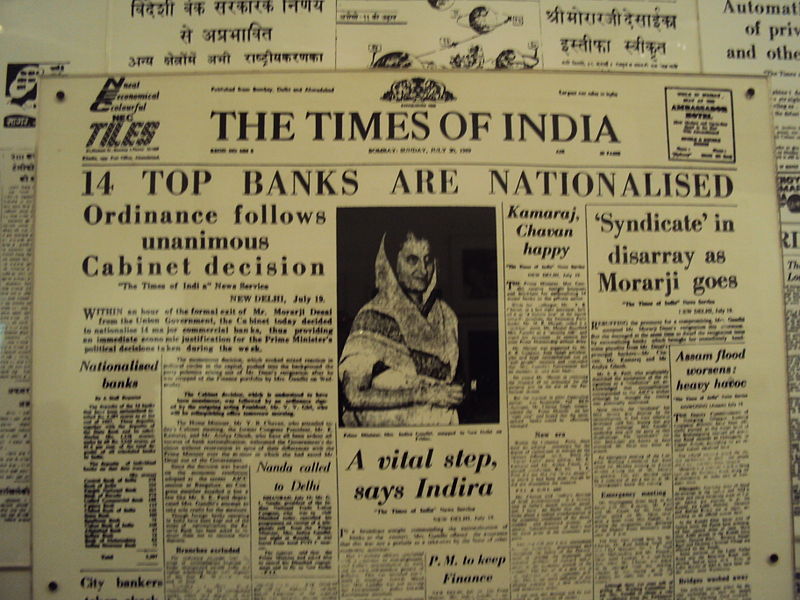
Bank Nationalisation - 42 years of Socio-Economic Justice in India.

ON July 19, 1969 - forty two years ago - 14 major private banks were nationalised in India. It was what Jayaprakash Narayan, the veteran socialist-national leader of India, described the step as a "masterstroke of political sagacity", when Smt Indira Gandhi nationalized 14 Banks in 1969 and not only scored over her rivals in the Congress Party, all much senior and experienced, known as “Syndicate” group, but also won over the hearts of millions of Indians which made her sweep the General elections later. She had become the ‘messiah’ of the poor and people fell for her slogan “garibi hatao”. She said aptly, “Woh kahte hain Indira hatao, main kahti hoon Garibi Hatao”. Sadly, the Congress Party is moving on the policy of “Garib Hatao” as its decision making becomes quagmire of corporate dictation, forgetting the common man.

Let us see how bank nationalization happened and why? Today Reserve Bank of India is the central bank of the country. Central banks are a relatively recent innovation and most central banks, as we know them today, were established around the early twentieth century.The Reserve Bank of India was set up on the basis of the recommendations of the Hilton Young Commission. The Reserve Bank of India Act, 1934 (II of 1934) provides the statutory basis of the functioning of the Bank, which commenced operations on April 1, 1935.

The Bank began its operations by taking over from the Government the functions so far being performed by the Controller of Currency and from the Imperial Bank of India, the management of Government accounts and public debt. The existing currency offices at Calcutta, Bombay, Madras, Rangoon, Karachi, Lahore and Cawnpore (Kanpur) became branches of the Issue Department. Offices of the Banking Department were established in Calcutta, Bombay, Madras, Delhi and Rangoon.
Burma (Myanmar) seceded from the Indian Union in 1937 but the Reserve Bank continued to act as the Central Bank for Burma till Japanese Occupation of Burma and later upto April, 1947. After the partition of India, the Reserve Bank served as the central bank of Pakistan upto June 1948 when the State Bank of Pakistan commenced operations. The Bank, which was originally set up as a shareholder's bank, was nationalised in 1949.

Despite the provisions, control and regulations of Reserve Bank of India, banks in India except the State Bank of India or SBI, continued to be owned and operated by private persons. By the 1960s, the Indian banking industry had become an important tool to facilitate the development of the Indian economy. The Government of India issued an ordinance and nationalised the 14 largest commercial banks with effect from the midnight of July 19, 1969. Within two weeks of the issue of the ordinance, the Parliament passed the Banking Companies (Acquisition and Transfer of Undertaking) Bill, and it received the presidential approval on 9 August 1969.

A second dose of nationalization of 6 more commercial banks followed in 1980.

It is easy now to take for granted, or even to dismiss or disparage, what an extraordinary and important step that was. It was not a step taken at random or because of the whims of the leadership of the time, but reflected a process of struggle and political change which had made this an important demand of the people. The political situation at that time had some eerie similarities to the present one: a weakened Congress Party, in which Indira Gandhi sought to establish her position vis-à-vis the “syndicate” of older and more established Congress leaders by enlisting the support of left elements both within and outside her party. Bank nationalisation was one fallout of this political configuration, which had been placed on the agenda by progressive movements and campaigns for this. In these struggles, incidentally, hundreds of people even lost their lives, giving some idea of the intensity of the demand and the violence of the opposition.

The government's banking policy has paid rich dividends over the last five decades, especially after 1969 when 14 major private banks were nationalised. The policy has resulted in the creation of the massive network of the banking structure in the country. The major chunk of the structure was contributed by the nationalised banks, which number 27 at present.
According to bank economists, during the last 42 years of nationalisation, the branches of the public sector banks rose 800 per cent from 7,219 to 57,000, with deposits and advances taking a huge jump by 11,000 per cent and 9,000 per cent to Rs 5,035.96 billion and Rs 2,765.3 billion respectively.Contrary to the popular belief, employee productivity has been rising in the nationalised banks over the period, the economists said. Productivity per employee in respect of business volume (both deposits and advances) has gone up from Rs 250,000 in 1969 to Rs 4,780,000 in 1993. Accordingly, profits of these banks went up to Rs 30 billion in 1993 as against Rs 90 million at the time of the nationalisation, they said.

These banks also contributed to the generation of employment. Their staff strength increased by 300 per cent over the period to 900,000.


The economists said the growth of the banking sector after the nationalisation was unprecedented anywhere in the world. It is particularly true of branch expansion to every nook and corner of the country. While there were hardly any branch in the rural areas in 1969, 35,000 bank branches are operating there at present.
The need for the nationalisation was felt mainly because private commercial banks were not fulfilling the social and developmental goals of banking which are so essential for any industrialising country. Despite the enactment of the Banking Regulation Act in 1949 and the nationalisation of the largest bank, the State Bank of India, in 1955, the expansion of commercial banking had largely excluded rural areas and small-scale borrowers.

The developmental goals of financial intermediation were not being achieved other than for some favoured large industries and established business houses. Whereas industry’s share in credit disbursed by commercial banks almost doubled between 1951 and 1968, from 34 per cent to 68 per cent, agriculture received less than 2 per cent of total credit. Other key areas such credit to exports and small-scale industries were also neglected.

Question arises that with the policies being taken up and followed by the Government of India at present are the goals being met or are we becoming just another example of ‘Banana Republic’?
We have to think and decide.